ITEC 852 · WHITE PAPER · MAY 2026
The
Homemade Stack.
How L&D stopped waiting for IT.
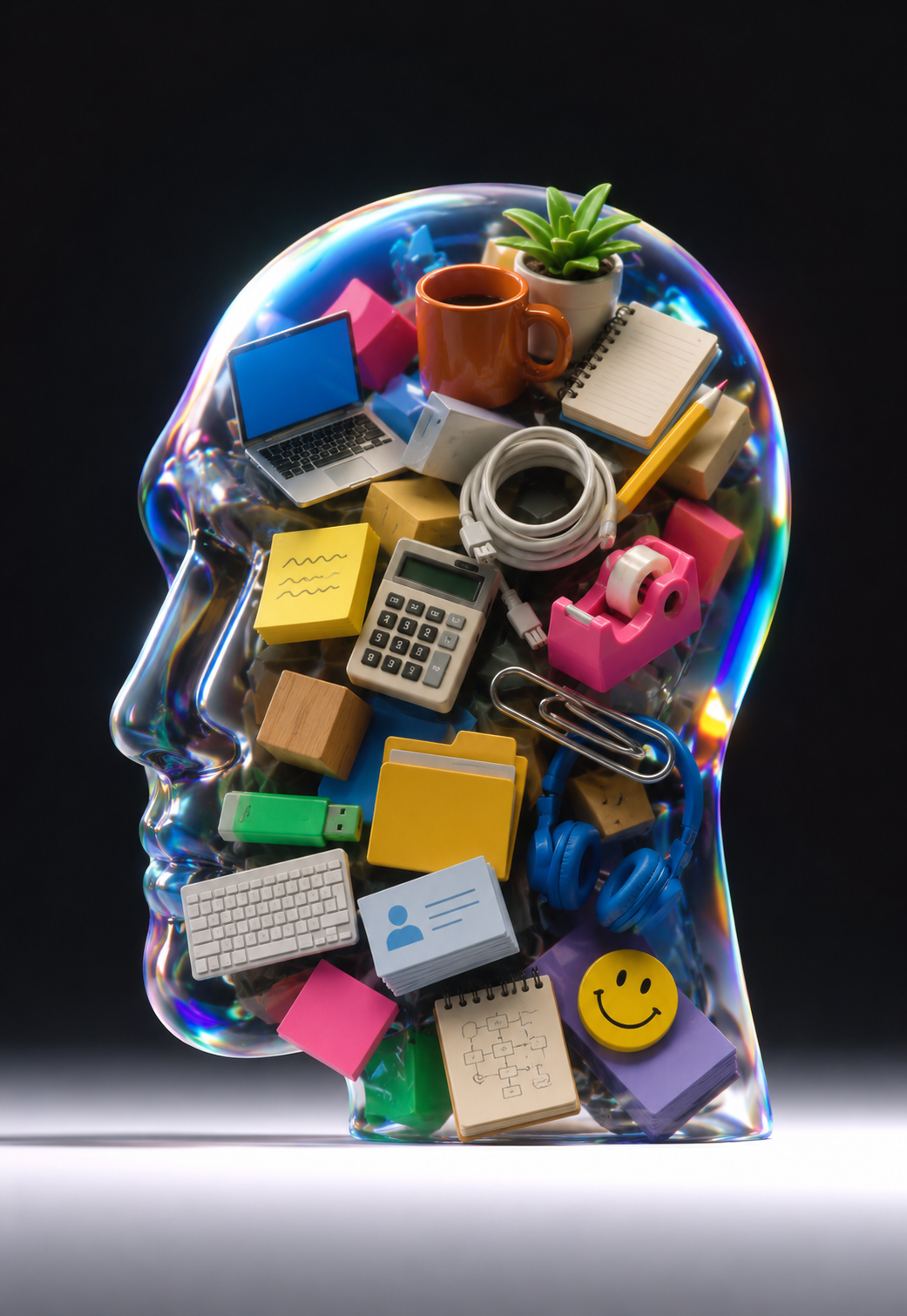
In 2026, the L&D stack increasingly lives on someone's desktop.
A GPT-powered workflow.
A no-code dashboard.
A prototype built before IT enters the conversation.
What's a stack?
A working definition
02 / 11
In the technology industry
The interconnected collection of software a team relies on is called a stack.
In 2026, for L&D, that stack is changing — fast.

HOMEMADE STACK
The old vendor stack.
The 2010s operating model
03 / 11
01
IT
procures.
procures.
Centralized procurement. Vendor contracts. Approval cycles measured in months.
02
Vendors
maintain.
maintain.
Canvas. Articulate Rise. Tableau. Updated on the vendor's schedule, not yours.
03
L&D
operates within.
operates within.
Practitioners worked inside whatever the platform allowed. The toolkit was given, not chosen.
HOMEMADE STACK
Then something shifted.
Change #1 — the technical floor lowered
04 / 11
Andrej Karpathy, 2025
"Vibe coding — building working software by describing what you want in plain language."
Claude · Cursor · Lovable · Replit
For a field where most practitioners do not write code, this changes who gets to build the tools that support the work.
HOMEMADE STACK
And the data caught up.
Change #2 — measurable productivity gains
05 / 11
+14%
More issues resolved per hour by support agents using generative AI.
The largest gains went to less experienced workers. Generative AI lowers the technical floor for what individuals can build and ship.
Brynjolfsson, Li & Raymond, Quarterly Journal of Economics (2025)
HOMEMADE STACK
Where organizations sit, 2026.
Donovan's AI adoption maturity model
06 / 12
DONOVAN (2026)
PHASE 01
Awareness
Org notices AI exists.
PHASE 02
Individual
Productivity
Productivity
Practitioners use AI to do existing tasks faster.
PHASE 03
Team
Workflow
Workflow
Workflows are redesigned around AI.
PHASE 04
Org
Integration
Integration
Systems and roles are reconfigured.
PHASE 05
Transformation
The work itself is rethought.
Most organizations remain in Phase 2. AI accelerates existing tasks rather than transforming them — and the homemade stack scales sideways inside this stage.
HOMEMADE STACK
From vendor to homemade.
Same functions. Different timelines. Different hands.
06 / 11
Function
Vendor Stack · 2010s
Homemade Stack · 2026
Thought partner
(None — training and SMEs)
Claude, ChatGPT
Authoring
Articulate Rise, Captivate
Lovable, Replit, vibe-coded HTML
Asset generation
Adobe CC, stock libraries
Midjourney, ChatGPT Image, Figma
Content mgmt
SharePoint, enterprise CMS
Notion, Airtable, Coda
Delivery / LMS
Canvas, Cornerstone, Workday
GitHub Pages, Vercel, "the desktop"
Automation
Custom IT integrations
Zapier, Make
Procurement
IT-managed, vendor contract
Practitioner-assembled
Time to deploy
Months
Hours
HOMEMADE STACK
What it wins. What it loses.
The core tradeoff
07 / 11
↑ Wins
Speed.
Flexibility.
Cost.
Flexibility.
Cost.
- 01Build and test a tool in hours, not weeks.
- 02No per-seat licensing. No procurement cycle. Little vendor lock-in.
- 03Direct engagement builds judgment and professional agency (Beane, 2024).
↓ Losses
Governance.
Security.
Sustainability.
Security.
Sustainability.
- 01Data spreads across personal tools.
- 02Practitioner-built dashboards surface unvetted information.
- 03The original builder is often the only one who can fix it.
HOMEMADE STACK
The reframe.
Same behavior. Two interpretations.
08 / 11
Old framing
Shadow IT.
- Unsanctioned
- Risky and ungoverned
- Should be suppressed
- Disconnected from strategy
- Owned by individuals
New framing
Homemade Stack.
- Practitioner-driven
- Fast and customized
- Should be supported
- An emerging operating norm
- Built into how work gets done
HOMEMADE STACK
So what now?
Implications for three audiences
09 / 11
ID Grad Programs →
Teach AI literacy, basic vibe coding, and stack-building alongside ADDIE and Kirkpatrick — not as specialty electives.
L&D Teams →
Without intentional professional development, the homemade stack doesn't fulfill its promise. It just produces inconsistent work faster.
The Field →
Foundational principles (needs analysis, learner-centered design, performance before content) stay intact. What changes is who gets to build.
HOMEMADE STACK
2030 →
10 / 11
The stack will be assembled,
not bought.
not bought.
The field trained workers for a century to wait for the official tool.
AI just told them they don't have to. L&D's next decade is about figuring out what to do with the practitioners who have stopped waiting.

References.
Selected works cited
11 / 11
BEANE
Beane, M. (2024). The skill code: How to save human ability in an age of intelligent machines. HarperBusiness.
BRYNJOLFSSON
Brynjolfsson, E., Li, D., & Raymond, L. R. (2025). Generative AI at work. QJE, 140(2), 889–942.
BUDD
Budd, E. (2023). Expert advice to help you build your technology stack for L&D. ATD.
DONOVAN
Donovan, M. (2026, April 29). Guest lecture: AI adoption, human judgment, and the future of work. ITEC 852.
KARPATHY
Karpathy, A. (2025, Feb 2). Vibe coding [Post]. X.
LEVINE
Levine, A., & Van Pelt, S. (2021). The great upheaval. Johns Hopkins University Press.
PERSHING
Pershing, J. A. (Ed.). (2006). Handbook of human performance technology (3rd ed.). Pfeiffer.
REED
Reed, K. (2026, April 22). Guest lecture: Partner enablement at Amplitude. ITEC 852.
DECK
Claude (Anthropic). Helped design and build this HTML deck — layout, typography, interactions.
IMAGES
ChatGPT Image (OpenAI). Editorial illustrations for slide visuals.
HOMEMADE STACK